 Ultimate guide
Organizing Your Pokédex Across Every Generation
Last Updated: November 26, 2026
Quick Summary
Organizing Pokédex data across generations works best when each game gets its own separate progress track, so a Scarlet save cannot inflate your Sword totals. Keep a master list of species and forms, let each game report against it, and log captures as they happen. Decide your rules for forms, duplicates and shinies before you start entering data.
- Keep a separate save for each game you actively play, even when Pokémon overlap.
- Use a National order master list for long-term totals and per-game views for progress.
- Record transfers as transfers, not fresh captures, to avoid inflated completion totals.
- Track shiny status as its own field so normal completion counts stay accurate.
- Decide your variant rules for regional and alternate forms before logging any data.
Table of Contents
- Why Organizing Your Pokédex Across Generations Gets Messy
- National Pokédex Order Versus Generation-Based Order
- Choosing a Living Dex Organizer That Fits Your Collection
- Tracking Each Game Separately With a Pokémon Collection Tracker by Game
- Handling Regional Forms, Alternate Forms, and Gender Differences
- Recording Transfers, Duplicates, and Shiny Status
- Comparing the Best Pokédex Tracker Setups for Your Playstyle
- Setting Up Your DexTrack Pokédex Across Every Game
- Frequently Asked Questions
Why Organizing Your Pokédex Across Generations Gets Messy
Organizing your Pokédex across every generation sounds simple until you actually try it, and the challenge of organizing Pokédex data across many games is where most players get stuck.
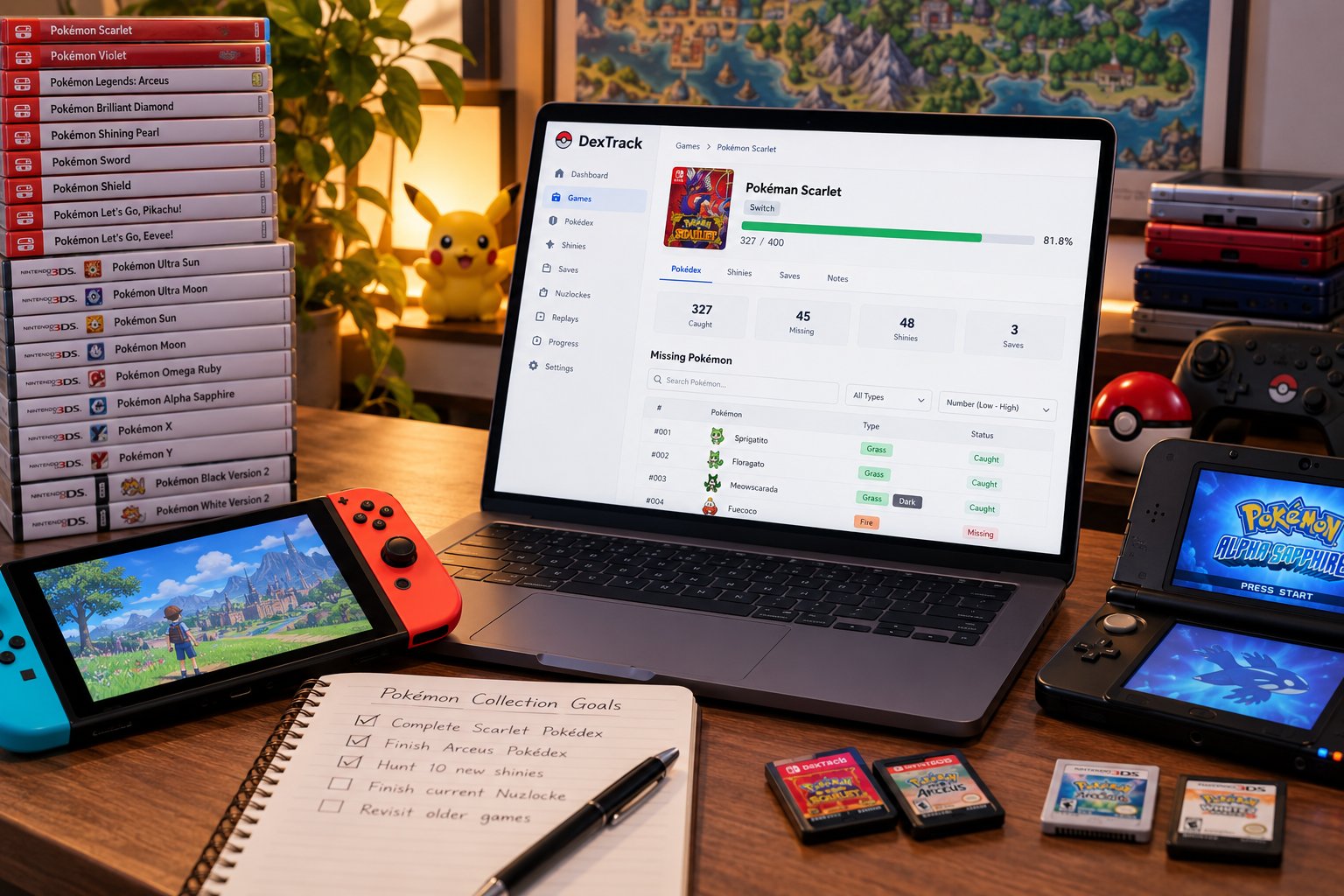
DexTrack is built for exactly this problem. It lets you monitor completion game by game, so a Scarlet save doesn't quietly inflate your progress in a Sword save.
The first problem is that games don't share a single list.
The second problem is shiny hunting.
The third problem is maintenance. Read how DexTrack's form and gender settings avoid double-counting completion totals to see how variants stay out of your totals.
National Pokédex Order Versus Generation-Based Order
There are two common ways to sort a collection. The National Pokédex order numbers every species in one sequence, so Bulbasaur is #001 and the newest Pokémon sit at the end of a single long list. The generation-based order groups Pokémon by the region and game generation that introduced them, so each generation reads as its own chapter.
The National order is the better choice when you want one master checklist and a single completion percentage. It makes it easy to see gaps across the whole franchise. Generation order is better when you play one region at a time and want each game's progress to feel self-contained.
Most collectors end up using both. A common setup is to track the National order as the long-term goal and keep a generation view for the game you're actively playing. A tracker that supports per-game progress makes this workable, because you can check the National total without losing the local picture.
Choosing a Living Dex Organizer That Fits Your Collection
A Living Dex is a collection that holds at least one of every Pokémon you can obtain across your games, including the forms you care about.
Start by separating the three layers of any Living Dex system:
- The master list, the full set of species and forms you consider part of the goal. This is your source of truth for what counts.
- The per-game progress, what you have actually caught or obtained in each save file. This is where completion percentages live.
- The physical or digital storage, where the Pokémon sit: game boxes, Pokémon HOME boxes, card binders, or a tracker's own records.
A common failure is collapsing these layers into one.
Here is how the main organizer types compare on the trade-offs that matter:
- Paper checklist or binder, best for physical card collections and for players who like writing by hand. Weakness: no automatic totals, and updating after a new generation means reprinting or rewriting pages.
- Spreadsheet, flexible and free, and it can hold transfer notes and duplicate counts. Weakness: you build every formula yourself, and it breaks when you add a game with a different obtainable list.
- Dedicated per-game tracker, strongest for players running several saves at once, because each game gets its own progress track and a new release does not force a rebuild. Weakness: you must still decide your variant rules up front.
- Pokémon HOME boxes, the natural home for a cross-game Living Dex, but HOME does not tell you which species you are missing across the whole franchise. It stores Pokémon; it does not grade your collection.
Be honest about your habits when you choose. If you replay games or run several Nuzlockes at once, you need separate saves, not a single shared list.
Watch out: Do not pick an organizer based on how it looks at the start.
The organizer types below trade off differently, so match them to how many games you run and how you store Pokémon.
| Organizer type | Best for | Key difference |
|---|---|---|
| Paper checklist or binder | Physical card collections, handwriting fans | No automatic totals; updates mean rewriting pages |
| Spreadsheet | Flexible, free tracking | You build every formula; breaks with new game lists |
| Dedicated per-game tracker | Players running several saves at once | Each game gets its own progress track |
| Pokémon HOME boxes | Cross-game storage | Stores Pokémon but does not grade your collection |
Tracking Each Game Separately With a Pokémon Collection Tracker by Game
Tracking by game is the single most useful habit for a multi-generation collection. Here's a practical setup you can follow:

- Create a separate save for each game you actively play. Don't merge them, even if the Pokémon overlap.
- Add the species list for that game first. Enter what the game can actually obtain, not the entire franchise.
- Record captures as you go. Log the Pokémon the moment you catch it, so you don't reconstruct your progress later.
- Mark shinies and variants separately. Keep shiny status as its own field so a shiny hunt doesn't overwrite your normal completion count.
- Review completion totals at the end of each session. A quick check keeps the numbers honest and shows you what's left.
This process takes about ten minutes per game to set up and a few seconds per session to maintain. Once it's running, switching between games should feel like opening a different folder rather than rebuilding your whole collection.
Watch out: Don't copy a full National Dex list into a single game's save. You'll end up with a completion percentage that can never reach 100% for that game, which is discouraging and tells you nothing useful.
Handling Regional Forms, Alternate Forms, and Gender Differences
Regional forms (Alolan, Galarian, Hisuian, Paldean) are treated as separate entries in the National Pokédex numbering in modern games, so give each one its own line in your master list.
Alternate forms that share a Pokédex number, Deoxys's four formes, Rotom's appliances, Giratina's Origin and Altered formes, Zacian's Hero and Crowned formes, should not each get a separate National Dex entry. Instead, record the base species once and use a form field or note to track which formes you have obtained. This keeps your completion total readable while still letting you pursue every forme.
Gender differences (Pikachu's tail, Hippopotas's coloring, Indeedee's form) follow the same logic as alternate forms: one species entry, with a note for which gender variants you have.
Cosmetic and event variants, Spinda patterns, Vivillon patterns, event-distributed Pokémon, are the most common source of double-counting.
Evolution lines deserve a placement rule too.
Write these rules down before you start entering data, and apply them the same way in every game.
Watch out: If you change your variant rule halfway through, every earlier entry becomes ambiguous. Decide the rules first, then log.
Recording Transfers, Duplicates, and Shiny Status
Transfers and duplicates are the quiet source of most tracking errors.
Keep a simple rule: a species counts once per collection goal, and a note records where and how you got it. If you transfer a Pokémon, log it as a transfer rather than a fresh capture.
Shiny status follows the same logic. For a consistent encounter-record workflow for shiny hunts in a specific game, see the shiny hunt planning guide.
Watch out: Changing a species' status after the fact is easy to forget. Update the record in the same session you make the capture, or the totals will drift out of sync.
Comparing the Best Pokédex Tracker Setups for Your Playstyle
No single setup suits everyone. Here's how to match a setup to how you play:
- Casual player, one or two games: A single checklist per game is enough. Keep it simple and skip the variant tracking.
- Completionist chasing the National Dex: Use a National order master list for the long-term total, with per-game views for progress.
- Shiny hunter: Track shiny status as a separate field and log every encounter, including the ones that didn't pay off, so you know how many attempts each target has taken.
- Nuzlocke runner: Keep each run in its own save so team records stay separate from your main collection.
- Returning fan with a backlog: Start with the game you're playing now, then add older titles one at a time.
The best setup is the one you'll keep updating. A slightly simpler system that you use every week beats a detailed one you abandon after a month.
Setting Up Your DexTrack Pokédex Across Every Game
Here's how we'd set up DexTrack from scratch so it stays organized as your collection grows:
- Pick one goal. Decide whether you're working toward a single game's Pokédex, a regional total, or the full National Dex. You can always add goals later.
- Create a save for each game you're playing. Keep separate saves for main playthroughs, replays, and Nuzlocke runs so their progress never blends together.
- Turn missing Pokémon into a checklist. Use the list of what's still missing as your session plan. Pick one or two targets per session instead of trying to finish everything at once.
- Track shinies on their own track. Log shiny status separately so your normal completion number stays clean.
- Add new games as they release. Because DexTrack handles each title as its own progress track, a new release doesn't mean rebuilding everything you've already entered.
A free plan is available. You can explore the plan features on the DexTrack website, and pricing details are listed there rather than here.
Organizing your Pokédex across every generation comes down to one habit: keep each game's progress separate, decide your variant rules early, and log captures the moment they happen. Get those three right, and a collection spanning dozens of games stays manageable.
Start by creating your first save at dextrackapp.com, then add the game you're playing today. Everything else can follow one game at a time.
Frequently Asked Questions
Can I transfer my Gen 1 Pokémon to Gen 9?
Transfers depend on the games and transfer services involved. Pokémon can generally move forward through the official transfer chain, most often via Pokémon HOME, but some older games cannot send Pokémon directly to newer ones. Check which titles are connected before moving anything, and keep a record in your tracker of where each Pokémon came from so you always know its origin and whether it is a duplicate.
How do you organize a Living Dex across multiple games?
Start by choosing one master ordering, usually National Pokédex order, so every species has a single fixed slot. Then track completion per game and per save file rather than in one blended list. A Living Dex organizer lets you mark which games a Pokémon appears in and whether you have it in a given save, so one species can be complete in one game and still missing in another.
What is the difference between a National Pokédex and a regional Pokédex?
The National Pokédex numbers every species across all generations in a single sequence. A regional Pokédex lists only the Pokémon found in one region or game, using that region's own numbering. Using National Pokédex order for your master list while keeping regional lists for each game gives you both a complete overview and accurate per-game progress.
How can I track shiny Pokémon in my collection?
Record shiny status as a separate field from completion, so a Pokémon can be caught, shiny, and tracked in each game independently. Note the game of origin and any Alpha status too. Keeping these as their own filters makes it easy to see your shiny count per title without losing track of which copy came from where.
What is the best way to track Pokémon across different games?
Use a single master list ordered by National Pokédex number, then add game-specific columns for caught, shiny, and location. This keeps each Pokémon in one place while still showing progress per game. A dedicated Pokédex tracker is easier to maintain than a spreadsheet once you pass a few hundred species across several titles.
Should I track Nuzlocke runs separately from my main save?
Yes. Nuzlocke teams have different rules, so mixing them with your main save blurs which Pokémon are permanent and which are lost to fainting. Create a separate save file or profile for each run so the team composition and progress stay independent of your completion tracking.