 ultimate-guide
How to Organize Your Pokémon Video Game Collection Across Every Game
Collecting Pokémon gets complicated surprisingly quickly.
You may start with one game and one Pokédex. A few years later, your collection is spread across multiple generations, cartridges, digital games, save files, shiny hunts, challenge runs, and Pokémon you transferred between games.
At that point, the challenge is no longer just catching Pokémon.
It's remembering what you caught, where you caught it, which save file it belongs to, and what you're still missing.
A good Pokémon video game collection system gives you one clear way to organize all of that progress without turning the hobby into spreadsheet maintenance.
Table of Contents
- Start With a Collection Goal You'll Actually Maintain
- Organize Pokémon by Game First
- Track Each Save File Separately
- Decide What Counts Toward Your Collection
- Build a Living Pokédex Without Losing Track
- Organize Shiny Pokémon Across Multiple Games
- Track Special Pokémon and Forms
- Keep Nuzlockes and Challenge Runs Separate
- Why Spreadsheets Get Difficult as Your Collection Grows
- Use a Pokémon Collection Tracker to Keep Everything Together
- Create a Simple Collection Routine
- Conclusion: Build a Pokémon Collection That Grows With You
- Frequently Asked Questions
Start With a Collection Goal You'll Actually Maintain
The best Pokémon collection system is the one you'll continue using.
Before tracking hundreds or thousands of Pokémon, decide what you're actually trying to collect.
Some players want to complete the Pokédex in every game they own. Others care primarily about shiny Pokémon. Some want a Living Dex containing one of every species, while others want to document every playthrough they've completed.
You might even be doing several of these at once.
Ask yourself:
- Do I want to complete the Pokédex in every Pokémon game I play?
- Am I building a Living Dex?
- Am I primarily collecting shiny Pokémon?
- Do I want to keep different playthroughs separate?
- Do I run Nuzlockes or other challenge saves?
- Do I care which game each Pokémon originally came from?
- Do I want to revisit older games and finish incomplete Pokédexes?
There isn't one correct collecting style.
What matters is having a system that reflects your collection goals.
Organize Pokémon by Game First
For players with multiple Pokémon games, the easiest place to start is with the game itself.
Treat each game as its own collection.
A completed Pokédex in one title shouldn't automatically mean you've completed it everywhere else.
If you've caught Pikachu in one game but never obtained it in another, those are two different pieces of collection progress.
This becomes increasingly important when you play across multiple generations.
Your collection might include:
- A completed older save
- A partially completed Pokédex
- Your current main game
- A second playthrough
- A challenge run
- A shiny-hunting save
- An unfinished game you plan to return to later
Separating collection progress by game makes it much easier to answer a simple question:
What am I still missing in this game?
Instead of looking at one enormous list of Pokémon, you can focus on the Pokédex you're actually working on.
Track Each Save File Separately
The game itself isn't always enough.
Many collectors replay Pokémon games multiple times.
Your first save might be your main collection, while another save is a Nuzlocke. You may have another playthrough dedicated to completing the story again or trying a different team.
Combining all of those saves into one checklist quickly creates confusion.
Instead, treat each save file or playthrough as its own collection.
For example:
Main Save
- Pokédex completion
- Shiny collection
- Long-term Pokémon storage
Nuzlocke
- Pokémon obtained during the run
- Run-specific progress
- Separate completion history
Replay
- New Pokédex progress
- Different team
- Independent collection history
Keeping saves separate lets you preserve the story of each playthrough without overwriting your main collection data.
Decide What Counts Toward Your Collection
Not every collector defines "complete" the same way.
Before you start tracking everything, decide what counts for you.
A basic collection might only track whether you've obtained each Pokémon species.
A more detailed collection might include:
- Every Pokémon species
- Shiny Pokémon
- Regional forms
- Alternate forms
- Gender differences
- Special variants
- Alpha Pokémon
- Pokémon from specific games
- Pokémon obtained during challenge runs
The more detailed your goal becomes, the more important consistent tracking becomes.
Someone trying to complete a regional Pokédex can work from a relatively simple checklist.
Someone trying to maintain collections across several Pokémon games needs something more structured.
Build a Living Pokédex Without Losing Track
A normal Pokédex only asks whether you've encountered or caught a Pokémon.
A Living Pokédex takes collecting further by keeping one representative of every Pokémon in the collection.
That creates a different organizational challenge.
Instead of asking:
Have I caught this Pokémon?
You're asking:
Do I currently have this Pokémon in my collection?
Those aren't always the same thing.
Pokémon may be evolved, traded, transferred, or moved between games. Without a tracking system, it's easy to think you still have a species somewhere only to discover later that you evolved your only copy.
When building a Living Dex, work through your collection systematically.
Start with one game or one Pokédex section at a time. Fill the missing spaces, update your tracker, and then move to the next group.
The goal is to always know exactly which Pokémon you're missing instead of repeatedly searching through storage boxes.
Organize Shiny Pokémon Across Multiple Games
Shiny hunting creates one of the biggest Pokémon tracking problems.
A shiny collection rarely stays inside one game.
Over time, you might hunt Pokémon across several titles, generations, save files, events, and playthroughs.
Without some kind of catalog, it becomes surprisingly easy to forget:
- Which shinies you've already caught
- Which game they're from
- Which species you still need
- Whether a shiny was caught on your main save or another run
- Whether you've hunted the same Pokémon more than once
A good shiny tracking system should let you see both your overall collection and your progress inside individual games.
That way, catching a shiny in one title doesn't make it look like you've completed the same goal everywhere else.
For collectors who shiny hunt regularly, updating your collection immediately after a successful hunt is much easier than trying to reconstruct everything months later.
Track Special Pokémon and Forms
Species alone don't always tell the full story of a Pokémon collection.
Different games may contain alternate forms, regional variants, or special versions that collectors want to track independently.
Some games also introduce collection goals that matter specifically within that title.
For example, a collector playing Pokémon Legends: Arceus may want to distinguish normal Pokémon from Alpha Pokémon.
Your tracking system should be detailed enough to recognize those differences without forcing every collector to track them.
If Alpha Pokémon matter to your collection, track them.
If you're only interested in basic Pokédex completion, you don't need to turn a simple checklist into a database.
The system should support your collecting goals rather than create extra work.
Keep Nuzlockes and Challenge Runs Separate
Challenge runs are collections of their own.
A Nuzlocke shouldn't necessarily share the same progress as your main save, even when both runs are from the same game.
The Pokémon you catch, use, lose, and finish the game with are part of that specific run.
Tracking the run independently lets you preserve that history.
The same idea applies to:
- Nuzlockes
- Monotype runs
- Professor Oak-style challenges
- Replay saves
- Shiny-only challenges
- Other self-imposed challenge runs
Instead of treating these as temporary saves that disappear when you're finished, you can keep a record of what you accomplished.
For long-time Pokémon players, that turns your collection tracker into something closer to a history of your Pokémon adventures.
Why Spreadsheets Get Difficult as Your Collection Grows
Spreadsheets work well when your collection is small.
You can create columns for Pokémon names, game titles, shiny status, completion status, and anything else you want.
The problem appears when the collection expands.
You may eventually need to track:
Tracking Method | Best For | Main Limitation |
|---|---|---|
Paper checklist | One game or a small Pokédex | Difficult to search and update |
Spreadsheet | Custom tracking for a few games | Becomes complicated across many saves |
Dedicated Pokémon tracker | Multiple games, saves, shinies, and challenge runs | Requires you to keep your collection updated |
A spreadsheet may start with one tab.
Then you add another game.
Then another save file.
Then shiny status.
Then a Nuzlocke.
Then another generation.
Eventually, you're spending more time maintaining the spreadsheet than using it.
That's usually the point where a dedicated collection tracker becomes more useful.
Use a Pokémon Collection Tracker to Keep Everything Together
This is the problem DexTrack is designed to solve.
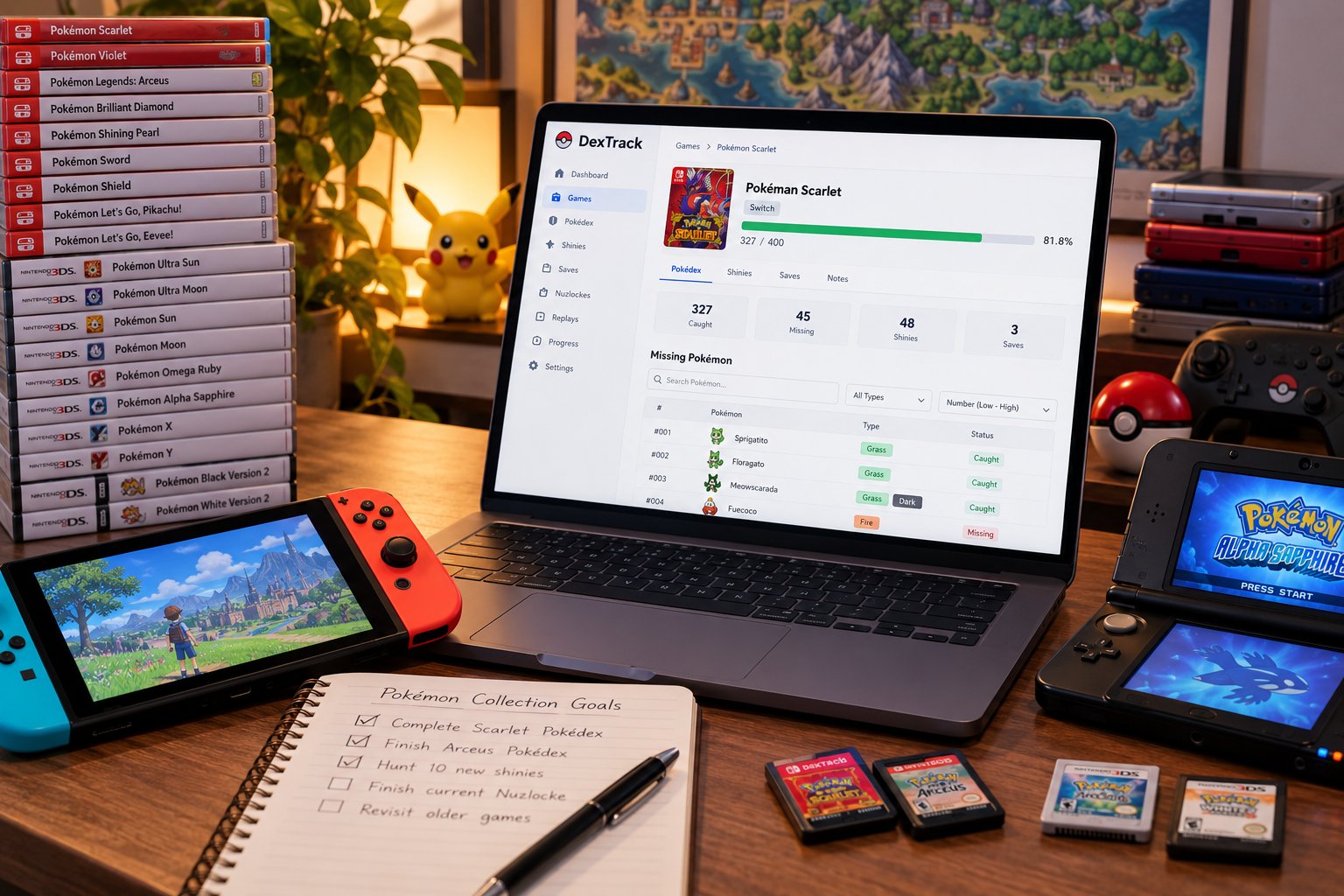
Instead of combining every Pokémon you've ever caught into one enormous checklist, DexTrack lets you organize collection progress around the games and saves you're actually playing.
You can use DexTrack to keep track of:
- Pokédex progress by game
- Per-game completion percentages
- Multiple saves and playthroughs
- Main saves
- Nuzlockes
- Replays
- Shiny Pokémon
- Alpha Pokémon
The goal isn't simply to tell you that you've caught a Pokémon somewhere.
It's to help answer questions like:
Which Pokémon am I missing from this game?
How close am I to completing this Pokédex?
Did I already catch this shiny?
Which save file was I using for this run?
How much progress have I made across all the Pokémon games I'm playing?
That becomes much more useful as your collection grows.
Track Pokédex Completion Across Every Game
Completing one Pokédex is satisfying.
Trying to complete several of them is where organization becomes important.
Your collection might be spread across older cartridges, newer games, current playthroughs, and saves you haven't opened in years.
Instead of treating that scattered progress as one collection, record completion independently for every game.
A simple routine works well:
- Choose the Pokémon game you're currently playing.
- Review which Pokémon you're still missing.
- Catch, evolve, or obtain the Pokémon you need.
- Update your collection after the play session.
- Check your completion percentage.
- Move to another game when you're ready.
Working game by game makes a huge collection feel manageable.
You aren't trying to "finish Pokémon."
You're trying to finish one specific Pokédex at a time.
Create a Simple Collection Routine
The hardest part of any tracking system isn't setting it up.
It's keeping it accurate.
You don't need to update your collection every five minutes.
Create a routine that's easy enough to maintain.
For example:
- Log important catches after each play session.
- Mark shiny Pokémon as soon as you catch them.
- Update Alpha Pokémon when relevant.
- Keep separate progress for each save.
- Review incomplete Pokédexes occasionally.
- Check completion percentages before deciding what to hunt next.
Even a short update at the end of a session can prevent hours of confusion later.
The more consistently you track your collection, the more useful it becomes.
Don't Let Old Pokémon Games Become Forgotten Progress
Long-time players often have collection progress scattered across years of Pokémon games.
You may have an older cartridge with a nearly completed Pokédex that you haven't touched in years.
Another game may contain shinies you forgot you caught.
A newer save may be halfway through its regional Pokédex.
Instead of starting over every time you return to an older game, add that progress to your collection system.
You don't need to catalog everything in one day.
Start with the game you're currently playing.
Then gradually add older saves whenever you revisit them.
Eventually, your tracker becomes a record of your Pokémon collection across generations rather than a checklist for only your newest game.
Conclusion: Build a Pokémon Collection That Grows With You
Pokémon collecting doesn't end when the credits roll.
There is always another Pokédex to finish, shiny to hunt, save to start, challenge to attempt, or older game to revisit.
The larger your collection becomes, the more valuable organization becomes.
The simplest approach is:
Track each game separately.
Keep different saves and playthroughs separate.
Decide what matters to your collection.
Update your progress consistently.
DexTrack is built around that approach.
You can track your Pokémon collection game by game, monitor Pokédex completion percentages, manage separate main saves, Nuzlockes, and replays, and record shiny and Alpha Pokémon without maintaining an increasingly complicated spreadsheet.
Create a free DexTrack account and start organizing your Pokémon video game collection in one place that can grow with every game you play.
Frequently Asked Questions
What is the best way to organize a Pokémon video game collection?
Start by separating your collection by game. Track Pokédex progress independently for each title, then separate different saves or playthroughs when necessary. This keeps your collection easy to understand as you add more games.
Should I track every Pokémon game separately?
Yes. If completing individual Pokédexes matters to you, each game should have its own progress. Catching a Pokémon in one game doesn't necessarily mean you've completed the same goal in another.
How should I track shiny Pokémon across multiple games?
Record shiny status alongside the game or save where the Pokémon was obtained. This makes it easier to see your total shiny collection without losing track of which games you've hunted in.
What is a Living Pokédex?
A Living Pokédex is a collection where you keep one representative of each Pokémon rather than simply registering each species as caught. Because Pokémon may be evolved, transferred, or traded, a Living Dex usually requires more organization than ordinary Pokédex completion.
Should Nuzlocke saves be tracked separately?
Yes. A Nuzlocke or other challenge run represents its own playthrough and collection history. Keeping it separate prevents its Pokémon and progress from being mixed with your main save.
Is a spreadsheet good for tracking a Pokémon collection?
A spreadsheet can work well for one or two games, especially if you want completely custom fields. As you add more games, saves, shiny hunts, and challenge runs, however, maintaining multiple sheets and columns can become cumbersome.
What can DexTrack track?
DexTrack is designed for players collecting across multiple Pokémon video games. It can be used to track per-game Pokédex completion, separate saves and playthroughs, Nuzlockes, replays, shiny Pokémon, and Alpha Pokémon.
How often should I update my Pokémon tracker?
Updating after each play session is the easiest approach, especially after major catches or successful shiny hunts. Regular updates keep your collection accurate and prevent you from having to reconstruct months of progress later.
Frequently Asked Questions
How do you organize Pokémon cards in binders?
Pick one primary sort: set order, card number, Pokémon type, or rarity. Load cards into binder pages front-facing so artwork stays visible, and leave gaps for missing cards when building a master set. Use a separate binder for high-value holo and full art cards, and keep a small trade binder for duplicates. Label each binder spine with the set name and card number range so you can find any card in seconds.
What is the best way to sort a Pokémon card collection?
There is no single best way, only the way that matches your goal. Building a master set? Sort by set then card number. Chasing a living dex? Sort by Pokédex number. Trading often? Group by type or rarity. Most collectors run two systems side by side: a binder for the collection and a storage box for bulk. Decide your goal first, then pick the sort that supports it.
What should I do with bulk Pokémon cards?
Separate bulk from anything worth protecting. Pull out holo, full art, and first-edition cards first, then sleeve and store the rest in row boxes sorted by set or type. Bulk works well for trade piles, donation to schools or clubs, or local card shop credit. Keep a small labeled box of playable commons and uncommons for deck building so you never dig through the whole pile again.
How can you track which Pokémon you own across different games?
Use a Pokédex completion tracker that separates saves by game. DexTrack, for example, shows per-game completion percentages and lets you keep main saves, Nuzlocke runs, and replays in independent files so progress never blurs together. Mark each entry caught, shiny, or Alpha as you go, and update after every session. A tracker beats a spreadsheet because it stays organized as you add new titles.
How do you keep track of shiny and Alpha Pokémon?
Log them the moment you catch them. In DexTrack you can flag a Pokémon as shiny or Alpha inside its game file, so a shiny Charmander in one save stays separate from a shiny Charmander in another. Add the encounter method and date in your notes, then review the shiny list weekly. Tracking status this way stops duplicates and helps you plan which hunts to run next.
Should you organize Pokémon cards by set, type, rarity, or Pokédex number?
Match the sort to the job. Set and card number order is best for master sets and completing a specific expansion. Type order suits deck builders and traders. Rarity order protects value and makes it easy to spot your best cards. Pokédex number works for collectors focused on the Pokémon itself rather than the print. Many collectors combine two: set order in binders, type order in bulk boxes.