 how-to
How to Manage Different Playstyles
Table of Contents
- Why Playstyle Differences Matter in Pokémon
- Identifying Your Playstyle and Your Team's
- Managing Multiple Pokémon Save Files for Different Approaches
- Using a Pokémon Nuzlocke Tracker for Challenge Runs
- Organizing a Pokémon Shiny Hunting Tracker Alongside Other Goals
- Building a Competitive Pokémon Team Tracker for Serious Players
- Adapting Your Strategy When Playstyles Clash
- Frequently Asked Questions
Last Updated: October 14, 2026
Why Playstyle Differences Matter in Pokémon
Every Pokémon player approaches the games differently, shiny hunting, Nuzlockes, competitive teams, Pokédex completion, and each goal demands different strategies, team compositions, and tracking needs.
The problem isn't that these playstyles exist, it's managing them all at once without losing track of each save file.
This is where understanding how to manage different playstyles becomes critical. Organize upfront and you stop losing progress, stay motivated across runs, and actually finish what you start.
Identifying Your Playstyle and Your Team's
The first step in managing different playstyles is naming what you actually do. You can't organize what you haven't defined.

Your playstyle is your approach to the game, shaped by what motivates you:
- Collection-focused players want to catch everything. Their goal is a complete Pokédex across all generations. Progress means completion percentage, not battle wins.
- Shiny hunters have one goal: rare color variants. They track specific statuses, spawn rates, and hunting methods. Success looks like finding that one rare Pokémon.
- Challenge runners (Nuzlocke players) add rules to make the game harder. They track team composition, deaths, and strict ruleset adherence. Progress means surviving further than last time.
Identifying which of these describes you (or which combination) is your starting point, though your playstyle often changes by game. You might be a collector in one title and a Nuzlocke runner in another.
A quick self-assessment: the four-question check
Answer these four questions for each save file, and write the answers down, don't keep them in your head.
- What does "done" look like? (Complete Pokédex, surviving Route 10, winning 10 ranked battles, catching one specific shiny.)
- What am I willing to lose? (Time, team members, competitive rank, story immersion.)
- How often do I want to play? (Daily, weekly, only when a new event drops.)
- What breaks my focus fastest? (Grinding, breeding, resetting, route planning.)
If two save files give the same answers to all four questions, they can share a tracking system. If they differ on two or more, they need separate tracking. This is the fastest way to decide whether a new playstyle deserves its own save file.
Mapping playstyles to team roles
When coordinating with other players, or assigning yourself roles across saves, match each playstyle to the responsibility it naturally supports:
- Collectors make good archivists. They're already tracking completion, so they can maintain the shared checklist of what the group has caught.
- Shiny hunters make good scouts. They spend long sessions in specific routes and notice spawn patterns, weather cycles, and event windows early.
- Challenge runners make good testers. Their strict rulesets surface which strategies actually hold up under pressure.
This mapping isn't about hierarchy. It's about putting each playstyle where its natural habits already do the work.
Compatibility check before you commit
Before merging two playstyles into one save file or shared tracker, run this three-point compatibility check:
- Shared resources? Do both playstyles need the same Pokémon, items, or routes? If yes, expect conflict and plan a split.
- Shared timeline? Do both goals have deadlines in the same week? If yes, one will slip. Rank them.
- Shared tracking needs? Do both playstyles track the same data points (e.g., encounter counts, team composition)? If yes, one tracker can serve both. If no, keep them separate.
The real difference between players who stick with multiple saves and those who abandon them: they know exactly what they're tracking and why. Clear goals create clarity.
Managing Multiple Pokémon Save Files for Different Approaches
Once you know your playstyles, separate them physically: independent save files with their own tracking systems.
Most players track everything in one spreadsheet or notes app, then get confused about which Pokémon belongs to which save, which team is which, and which rules apply to which run.
The fix is simple: one playstyle, one save file, one tracking system.
Here's how to organize this:
- Create separate save files for each major playstyle. If you're running a main save and a Nuzlocke, those are two different files. Your brain needs that separation.
- Label each save clearly. Don't name them "Save 1" and "Save 2." Name them "Main Collection" and "Nuzlocke Run 3" or "Shiny Hunt - Pokémon Legends." The name tells you what you're doing the moment you see it.
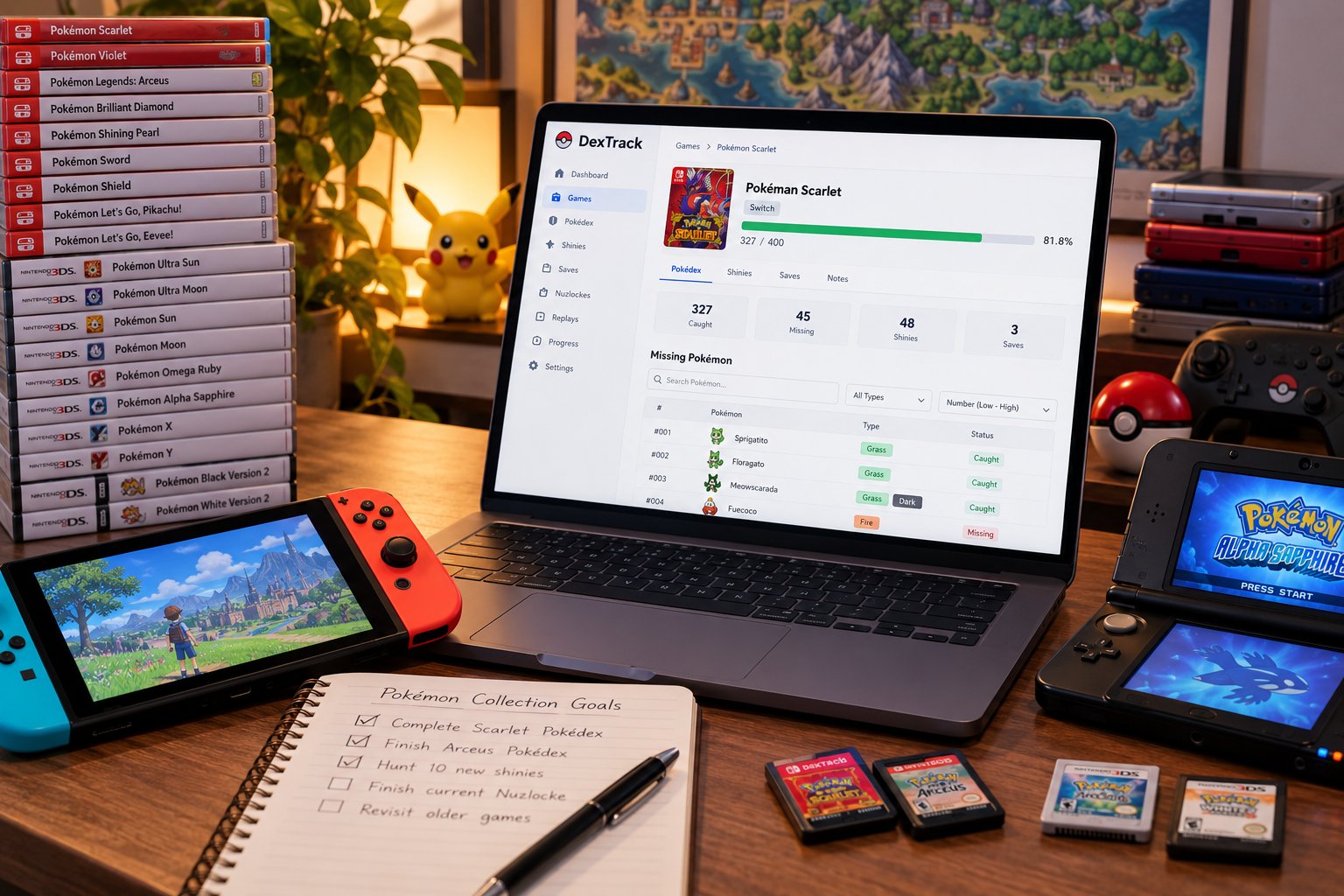
- Assign one tracking system per save. If you're using DexTrack, create a separate tracker entry for each save file. This keeps your data organized and prevents mixing up progress across different approaches.
Organizing upfront saves hours of confusion later. Players who manage multiple Pokémon save files successfully treat each as its own project with its own rules and tracking.
Using a Pokémon Nuzlocke Tracker for Challenge Runs
Nuzlocke runs are one of the most demanding playstyles. You add rules, catch only the first Pokémon on each route, release fainted team members, avoid repeats, and those constraints create real stakes.
The challenge is tracking all of this without losing focus mid-run.
A dedicated Nuzlocke tracker keeps your team, ruleset, and progress visible in one place. What matters:
- Track your active team. You need to see which Pokémon are alive, which are benched, and which are dead. This isn't optional, it's how you know if you're still in the run or not.
- Log each battle result. Did your team member survive? Did someone faint? Did you catch a new recruit? Write it down. This creates a narrative of your run and helps you learn what went wrong if the run ends.
- Note your ruleset clearly. Are you allowing Pokémon Center visits? Held items? Potions? Write your specific rules down so you don't accidentally cheat or forget a restriction mid-run.
When you manage different playstyles like Nuzlockes, the tracker becomes your safety net. It prevents mixing up which Pokémon are alive in this run versus your main save, and keeps your ruleset visible so you don't break your own rules halfway through.
Organizing a Pokémon Shiny Hunting Tracker Alongside Other Goals
Shiny hunting lives alongside your other saves, you're not replacing your main save or Nuzlocke run, just running a hunt in parallel.
The problem: shiny hunting progress is easy to lose track of.
A shiny hunting tracker solves this by giving you one place to log:
- Target Pokémon. Which shinies are you hunting? List them with the game, location, and method (random encounters, breeding, soft resets, etc.).
- Encounter counts. How many times have you encountered the Pokémon? This matters because some hunts take thousands of encounters. Seeing your count climb creates motivation.
- Hunting method used. Different methods have different odds. Tracking which method you used helps you understand your progress and adjust your strategy if you're not getting results.
The key insight: shiny hunting progress needs its own space.
Many serious hunters maintain a shiny hunting tracker independent from their other saves, so they can see at a glance which hunts are active, complete, or stalled.
Building a Competitive Pokémon Team Tracker for Serious Players
Competitive play requires precision, breeding for natures, training for stats, and building teams that counter the current meta.
A competitive team tracker is different from a casual tracker. It needs to show:
- Individual Pokémon stats. Nature, IVs, EVs, held item, moveset. Competitive viability depends on these specifics.
- Team composition. Which six Pokémon are you running? How do they cover each other's weaknesses? What's your strategy against common threats?
- Breeding progress. If you're working toward competitive-ready Pokémon, track which ones are ready and which need more breeding.
When you manage different playstyles as a competitive player, the tracker becomes your competitive advantage, keeping you organized so you can focus on strategy instead of remembering movesets.
Adapting Your Strategy When Playstyles Clash
Sometimes your playstyles conflict. You want a Pokémon for your Nuzlocke run but you're also hunting its shiny form, or you want to breed a competitive team while completing your Pokédex.
These conflicts are normal. The question is how you handle them.
Step 1: Name the conflict out loud
Most clashes stay unresolved because nobody says what's actually wrong. Instead of "stop playing like that," try a three-part script:
- "I notice...", State the behavior without judgment. "I notice you've been soft-resetting for the same shiny for three hours."
- "I need...", State your own goal. "I need to finish this Nuzlocke route before the weekend."
- "Can we...", Propose a concrete split. "Can we alternate saves every 30 minutes?"
This works whether the "other player" is a friend on the couch, a co-op partner, or your past self juggling two save files.
Step 2: Pick a compromise model
There are four workable models. Choose one before the session starts, not mid-run:
- Time-boxing, Each playstyle gets a fixed block (e.g., 45 minutes of shiny hunting, then 45 minutes of Nuzlocke). Best when both goals are long-term.
- Save-swapping, One playstyle owns the active save for a full session; the other waits. Best when context-switching causes mistakes.
- Parallel saves, Both playstyles run simultaneously on different files. Best when the goals don't share resources (e.g., a collection save and a challenge run).
- Priority ladder, Rank playstyles 1-3 for the week. Only the top one gets active play time; the others get maintenance (checking trackers, planning teams). Best when one goal has a deadline, like a tournament or a new game release.
Step 3: Escalate only when the model breaks
If the chosen model keeps failing, you keep breaking Nuzlocke rules because you're distracted by a shiny hunt, or you keep missing collection goals, escalate in this order:
- Re-state the goal. Say which playstyle is slipping and why it matters.
- Change the model. Move from time-boxing to save-swapping, for example.
- Separate completely. If two playstyles still interfere, give each its own save file and its own tracking system. This is the nuclear option, but it works.
Step 4: Log the resolution
Whatever you decide, write it down in your tracker. A one-line note like "Nuzlocke takes priority until Friday; shiny hunt paused" prevents the same argument next session.
When playstyles clash, the player who wins is the one who planned ahead. You can't adapt mid-run if you haven't decided what you're adapting to. Your tracker becomes the decision-making tool that prevents confusion.
Frequently Asked Questions
How do you manage multiple Pokémon playthroughs at once without mixing up your saves?
Use a dedicated tracking tool to maintain separate records for each playthrough. Assign each save file a clear label (main, Nuzlocke, shiny hunt) and track team composition, progress, and specific rules independently. DexTrack lets you create isolated save files so you can run multiple playstyles simultaneously without confusion, whether you're balancing a casual run against a competitive team build.
What should you record when building a competitive Pokémon team tracker?
Track each Pokémon's nature, individual values (IVs), effort values (EVs), moveset, ability, and held item. Record battle outcomes, win rates against specific archetypes, and adjustments made after losses. A competitive Pokémon team tracker also helps you identify which team members perform well in different matchups and highlights gaps in your strategy that need addressing through role adjustments or team composition changes.
How can you keep a shiny hunt separate from a regular playthrough?
Maintain independent save files and use a Pokémon shiny hunting tracker to log encounters, odds, and progress separately from your main game. Record spawn locations, methods used (chaining, breeding, soft-resetting), and time invested per hunt. This separation prevents your hunting data from cluttering your main playthrough records and lets you focus on completion goals without the distraction of long-term hunting mechanics.
What happens if I want to add a new Pokémon game to my collection tracker after I've started using it?
DexTrack is built to be future-ready, so adding new Pokémon titles doesn't require rebuilding your entire setup. You can add new games without code changes, meaning when the next generation releases, you'll integrate it into your existing collection without losing your historical data or starting from scratch.